Category: Uncategorized

  • Your Path to Wellness: Building Healthy Habits for Every Season

    Healthy Habits for Every Season

    Every season brings with it weather conditions that challenge your mind and body. That means you must adapt to the different weather patterns by changing your habits as the Earth moves around the sun. Creating healthy habits to meet the shifts in the weather allows you to be comfortable, feel good, and not worry about your skin and body.

    The changing of the seasons tends to affect some people more than others, especially when dealing with a chronic condition. Here’s a look at some seasonal habits to include in your routines so you can live your best life.

    Spring

    Spring is the moment that the world starts to awaken and stretch after a long winter’s nap. There’s more sunlight during the day, the weather is warmer, and Mother Nature is making herself known. This is the time to take advantage of the pleasures of the season for both your physical and mental health, and build habits that boost your sense of wellbeing. Some of the habits you can incorporate include:

    • Take steps to prevent pollen and mold from affecting your respiratory system
    • Go for a walk as frequently as possible
    • Take your dog for a run to enjoy the fresh air and keep both of you active and happy
    • Evaluate your diet and make changes
    • Schedule your annual checkup
    • Eat fresh foods for maximum nutrition

    These and other healthy habits prepare you for the summer activities that are to come. Your body is in good shape and ready to adapt to the hot summer weather when it arrives.

    Summer

    Summer is about enjoying warm weather, outdoor activities, and summer vacations. It’s also the time of year when the sun is at its strongest, and your skin is at the highest risk of UV damage. You’re also at your most active during the summer, something that affects your body in various ways. In turn, your daily habits become very important when it comes to protecting your mind and body from the intensity of the weather and your activities.

    • Apply high SPF sunscreen on the exposed parts of your body
    • Add electrolytes to your water for maintenance and recovery
    • Wear clothes that have SPF protection for outdoor activities
    • Take frequent breaks when working or playing

    Also, make sure to get into beneficial habits. They can include:

    • Regular exercise outdoors
    • Buying local produce for quality nutrition
    • Getting away from your screens
    • Join a club or league
    • Head to the beach

    Make sure to wear the right kinds of clothing when you’re spending a lot of time outdoors. Look for tops that are made from breathable materials and let air flow through. These properties help you stay comfortable by wicking away moisture and helping you stay dry. The same goes for shorts and leggings because they’ll prevent chafing, letting you stay active for longer and free from discomfort.

    The overarching goal of summer activities is to get out of your home and engage with the world at large. Protecting your body and doing outdoor activities helps you enjoy the long, hot days of summer. In turn, you’ll feel like you got something out of the seemingly short season and be ready to unwind when fall weather comes through.

    Fall

    Fall ushers in shorter days and cooler weather that limit your physical activity. The most obvious solution is to head into the gym for the next few months, but you also need to consider other aspects of your health. The loss of sunlight tends to make you less active and deprives you of vitamin D, while the cooler weather signals the arrival of flu season. It’s time to get into a new set of habits to keep yourself healthy.

    • Add a vitamin D pill to your supplements
    • Get a flu shot and boosters to avoid contracting seasonal illnesses
    • Wash your hands frequently to get rid of bacteria and viruses
    • Cover your mouth when you cough or sneeze
    • Wear more layers to keep your core body temperature stable
    • Maintain a regular schedule of activities outside of work

    One of the effects on your mental health is seasonal affective disorder, but not everyone experiences it. If you find yourself feeling blue with the loss of daylight, get a lamp or light bulb that provides full-spectrum light and make it a point to spend time next to it every day. The light receptors in your brain respond to the stimulation and help improve your mood.

    The end of fall brings the arrival of winter, a season that can be as harsh as it can be beautiful. Your fall habits help you prepare for the challenges that come with cold and dry weather.

    Winter

    Winter is arguably the roughest season in terms of its effects on the body. The constant cold makes it feel like you’ll never be warm again, and the winds can make your face and hands hurt. These and other harsh conditions cause you to spend more time indoors in order to stay comfortable. But it’s still good to get into habits that help you make the most out of the winter wonderland and keep yourself stimulated.

    • Protect your face with moisturizers
    • Go out for a brief walk when the weather is moderate
    • Minimize the time you spend outdoors
    • Wear warm clothes, a scarf, gloves, and a hat
    • Reduce holiday stress
    • Eat nutritious foods to power your body

    Winter is hard on people with chronic conditions that affect their circulatory system. For example, a chronic condition like lymphedema results in poor blood circulation in the limbs. This makes it harder to stay warm and can also lead to other health issues. However, proper management of the swelling will help improve circulation and make it easier to stay warm with the right garments.

    Perhaps the best part about winter is that it leads to spring and warmer weather. You can look forward to wearing lighter garments, there’s more daylight for activities, and the gentle breezes make you feel good about the months to come.

    Combining Seasonal Habits With Ones You Should Do Year-Round

    Changes in the weather bring changes in your habits, but some habits need to be done year-round in order to protect yourself. Always drink as much water as you can, but adjust your intake to stay ahead of dehydration in hot or cold weather. Sunscreen is another good habit, and you can adjust the SPF level for seasons that tend to be cloudy. Last, but not least, make it a point to get enough sleep by sticking to a regular sleep schedule.

    It doesn’t take a lot of work to get into seasonal habits, and it’s only a little more effort to combine them with your existing daily habits. They help you maintain your wellness and lift your mood because you’ve taken steps to protect yourself against the environment.

  • Mastering Your Mind: A Guide to Subconscious Reprogramming

    Mastering Your Mind Guide to Subconscious Reprogramming

    Have you ever planned to wake up early and work out, only to hit the snooze button repeatedly? It’s like a tiny troublemaker in your mind, telling you to stay in bed instead of going for that run.

    But what if you could make that troublemaker your buddy and get your subconscious mind to cheer you on? Imagine it helping you feel great and do great things every day.

    Think of it as getting your mind’s secret power to work with you, not against you. You’re in the right place if you’re tired of fighting with yourself and want more happy vibes.

    We’re about to take a trip into your mind to improve things. It will be fun, and it might just be the best thing you can do for yourself. Ready to give it a try? Let’s go!

    Understanding the Subconscious Mind

    Think of your subconscious mind as a quiet helper, always working in the background. It’s different from your conscious mind, which is like the boss who makes all the decisions you’re aware of, like choosing what to eat or wear.

    But your subconscious is doing much work without you even noticing. It’s like your heartbeat – you don’t have to tell your heart to beat; it just does. In the same way, your subconscious mind helps control how you feel and act. It’s like a sunny day inside your head when it’s filled with positive emotions.

    The trick is getting your conscious and subconscious minds to work together. When they do, it’s easier to feel good and make choices that help you.

    The Role of the Subconscious in Daily Life

    Your subconscious mind is like a behind-the-scenes worker in your daily life. It’s always active, even when you are sleeping or daydreaming. This part of your mind holds all your past experiences, beliefs, and memories. It uses this information to influence how you act and what you think without you even realizing it.

    For example, if you’ve ever felt nervous before a big event without knowing why, that’s your subconscious mind at work. It’s bringing up old feelings linked to similar situations you’ve faced before. The subconscious isn’t just pulling strings on its own; it’s in constant communication with your conscious mind.

    They pass notes back and forth, sometimes leading to negative thoughts popping into your head out of nowhere. The key is to understand that these thoughts are just your subconscious mind chatting with your conscious mind, and you can change the conversation to something more positive.

    The Interplay Between the Conscious and Subconscious Mind

    Imagine your mind as a team, with the conscious part being the player who makes the quick passes and shots you see, while the subconscious programs are like the coach’s game plan that’s been practiced repeatedly. They work together to play the game of life.

    Every day, you make choices with your conscious mind, like what to have for breakfast or what clothes to wear. These choices are your visible actions. But underneath these choices, your subconscious programs are running. They’re like the habits and lessons you’ve learned without even thinking about them, and they can shape what you decide without you noticing. Sometimes, these programs can be limiting beliefs that hold you back, like thinking you’re not good at something because you failed once.

    However, you can change the game plan. For example, you can create new, more positive subconscious programs by starting a gratitude practice. This means you start looking for the good in your life, and after a while, your subconscious coach will begin to highlight these positives instead of the negatives. That’s how you can break free from those limiting beliefs and play a better daily game.

    The Journey to Reprogramming Your Subconscious

    When you start changing how your subconscious programming talks to you, it’s like going on a big adventure inside your mind. This programming is a mix of everything you’ve learned and felt throughout your life, and it can sometimes get in the way of what you want to do. It’s like having a radio in your head that’s always on, sometimes playing tunes that make you doubt yourself or feel bad.

    But the good news is that you can change the station to play your voice, one that cheers you on and helps you feel strong. To do this, you must face inner conflicts — the battles between what you want to do and what your subconscious programming whispers you can’t do. By listening to your voice more often, you can turn down the volume on those doubts and fears.

    It takes time and practice, like learning to play an instrument or ride a bike, but it’s a journey worth taking. Step by step, you’ll find that you’re in charge of the radio and can play the songs that lift you and push you forward.

    Identifying Subconscious Beliefs

    To understand what’s happening inside your mind, you need to have a strong sense of your beliefs. These are the ideas you carry around without even knowing it, like a backpack filled with invisible items. It can be tricky to spot these subconscious beliefs because they’re not out in the open.

    One way to get a better look at them is to relax and let your mind get quiet. Some people use tools like binaural beats, which are unique sounds that help your brain chill out and can make it easier for you to spot those hidden beliefs. Once you’re calm and focused, you can ask yourself questions about how you see the world and what you think about your future. It’s essential to use the present tense when discussing what’s happening now, not what happened in the past or what you wish for the future.

    This way, you can catch those sneaky beliefs and understand how they guide your everyday life. Then, once you know what they are, you can decide if they’re helpful or want to change them.

    Strategies for Subconscious Mind Reprogramming

    When embarking on the journey to reprogram your subconscious mind, it’s essential to approach the process with patience and commitment. Your reprogramming efforts should be consistent and tailored to your personal growth goals. One method that has shown promise in reshaping subconscious patterns is self-hypnosis, which allows you to influence your thought processes directly in a relaxed state.

    As you delve deeper into the layers of your mind, you may discover the ability to unlock beautiful things about yourself that were previously overshadowed by limiting beliefs. For those looking for guidance and structured methods to accelerate their progress, try these fastest ways to reprogram the subconscious mind, where you’ll find a wealth of knowledge and techniques specifically designed to support your transformation journey.

    Remember, the path to mastering your mind is personal, and these resources can be a valuable companion along the way.

    Techniques for Subconscious Mind Reprogramming
    Guide to Subconscious Reprogramming

    Regarding techniques for subconscious mind reprogramming, the use of binaural beats has gained popularity for its simplicity and effectiveness. These specially designed audio recordings play slightly different frequencies in each ear, which the brain processes as a single tone. This auditory illusion can encourage a state conducive to learning and mental reconditioning.

    By regularly listening to these binaural beats, many people have found it easier to reprogram their subconscious mind, embedding new, empowering beliefs and clearing away negative thought patterns. Whether you’re looking to boost confidence, enhance creativity, or instill a more positive mindset, incorporating binaural beats into your daily routine could be a game-changer in your self-improvement arsenal.

    Using Positive Affirmations to Shape Your Reality

    Positive affirmations are a powerful tool to reprogram your subconscious mind and foster new beliefs that align with your goals and aspirations. By repeatedly positively affirming your intentions, you signal to your subconscious that these concepts are essential and help to embed them more deeply into your thought patterns.

    This practice is common among successful people who understand the significance of maintaining a constructive inner dialogue. By consciously focusing on positive statements about themselves and their capabilities, they shape their reality to be more conducive to success and well-being. Simple affirmations like “I am capable of achieving my goals” or “I embrace challenges as opportunities for growth” can set the foundation for a mindset that looks for solutions and remains resilient in the face of adversity.

    Visualization and Its Impact on the Subconscious

    Visualization is a potent technique that can effectively reprogram your subconscious mind. When you vividly imagine achieving your goals, your mind becomes receptive, absorbing these images as real possibilities. This mental rehearsal primes your subconscious to align with the success you envision, making it more likely for these scenarios to unfold in your life.

    It’s similar to how athletes mentally rehearse their sports performance, which enhances their physical play. By consistently visualizing your desired outcomes, you’re training your brain to recognize and act upon opportunities that can turn your dreams into reality.

    Many have voted inline feedback that this practice has significantly contributed to their personal and professional successes. Embracing visualization can be a transformative step towards manifesting the life you aspire to live.

    Leveraging Knowledge for Subconscious Mastery

    In the quest for subconscious mastery, leveraging knowledge is a critical strategy that can feel weird initially, especially when it pushes you out of your comfort zone. This is because acquiring and applying new information to your life can challenge your beliefs and habits, which your subconscious mind might resist. However, this step out of the familiar can lead to significant growth and transformation.

    When you arm yourself with knowledge about how the mind works and different techniques for influencing it, you’re better equipped to make the changes that can lead to a more fulfilled and purposeful life. Remember, the discomfort you feel today is often the precursor to the breakthroughs you’ll experience tomorrow. Embrace the weirdness, and let it guide you towards a more enlightened path.

    Exploring Masculine Energy Through Reading

    In our quest to create stronger, more conscious versions of ourselves, most people tend to focus on physical or external transformations. However, mastering your mind and reprogramming the subconscious often requires diving into the rich world of literature. To truly understand and harness your masculine energy, exploring the depths of your psyche and the archetypes that govern it is essential.

    For those ready to embark on this transformative path, we’ve curated a list of Badass Divine Masculine Books To Master Your Masculinity. Each book is a treasure trove of wisdom, offering perspectives and practices that can shift how you view yourself and the world.

    To start redefining what masculinity means to you, check out these divine masculine books and allow yourself to be guided through the realms of the sacred and the strong. These selections are more than just reading material; they’re the companions you need as you navigate the waters of personal growth and conscious masculine expression.

    Understanding Your Male Archetype

    A pivotal step in subconscious reprogramming is to find out what your male archetype is. Recognizing this archetype can provide a powerful insight into your inherent strengths and the belief systems that drive your behavior.

    To listen to the whispers of your inner self and understand your archetype’s role in your life, it’s essential to reflect on your actions, reactions, and decisions. For instance, identifying whether you’re the King, Warrior, Magician, or Lover helps align your conscious desires with your subconscious patterns.

    This understanding can act as a compass, guiding your personal development and allowing you to navigate life more intentionally and clearly. Embrace the journey to self-discovery, for it is through this knowledge that you can truly begin to transform and reprogram the foundational aspects of your being.

    Practical Steps to Subconscious Reprogramming

    Subconscious reprogramming isn’t just a concept; it requires action and consistent practice. To change the deep-seated beliefs that shape your life, start with affirmations. Say positive statements about yourself out loud every day. This can help to replace negative thoughts that may be stuck in your subconscious. Visualization is another powerful tool. Spend a few minutes daily picturing yourself achieving your goals and living your desired life.

    Your brain often can’t tell the difference between what’s real and what’s imagined, so this can reinforce positive beliefs and outcomes. Don’t forget to reflect on your daily experiences. Writing in a journal can help you understand your behavior and catch any negative patterns. Lastly, surround yourself with positivity.

    Listen to inspiring talks, read uplifting books, and talk to people who encourage you to be your best self. These practical steps, done regularly, can create lasting changes in your subconscious mind.

    Establishing a Routine for Mind Mastery

    For effective subconscious reprogramming, it’s essential to establish a consistent routine. Like a garden that needs regular care to bloom, your mind requires daily attention to grow positively.

    Start by setting aside a specific time each day for mind mastery practices. This could be affirmations when you wake up, visualization during your lunch break, or journaling before bed. Consistency is critical—the more regularly you perform these activities, the more deeply they’ll be ingrained in your subconscious.

    Over time, this routine will become a habit, and these positive changes will unfold naturally in your life. Remember, reprogramming your mind isn’t a quick fix; it’s a journey that needs patience and persistence. By sticking to your routine, you’re laying the building blocks for a more controlled and empowered mindset.

    Overcoming Resistance and Embracing Change

    When you try to put new beliefs into your subconscious, your mind might push back. This is normal. It’s like when your muscles ache after you start a new workout. To overcome this resistance, create small. Introduce new ideas to your mind bit by bit.

    Think of it as telling your mind, “We’re just trying this out.” It makes the change less scary. Also, celebrate every little win. If you catch yourself thinking a positive new thought, give yourself credit. It will make your mind more open to keeping the change. If you hit a block, don’t fight it. Pause and ask yourself, “Why might my mind not want this change?” Often, your mind tries to protect you, but once you understand that, it’s easier to reassure yourself and keep going. Lastly, be patient and kind to yourself.

    Change takes time. If you keep at it and don’t give up, your mind will start to accept these new beliefs, and change will become a part of who you are.

    Advanced Techniques for Deep Subconscious Work

    Once you’ve got the basics down, you might be ready for advanced techniques to work on your subconscious. One powerful method is meditation. When you meditate, you quiet your busy mind and allow yourself to listen to your more profound thoughts. Sometimes, you might use guided meditations that are made to help change specific parts of your thinking.

    Another technique is hypnotherapy. This isn’t like the stage of hypnosis you see on TV. It’s a severe method where a trained person helps you reach a very relaxed state and talks to your subconscious directly. This can be a fast way to change old beliefs. You can also try ‘shadow work,’ which is about looking at parts of yourself that you usually don’t want to see or deal with.

    By understanding these parts, you can heal and change them. Remember, these methods can be robust, and sometimes, it’s best to do them with a professional who can guide you and ensure you’re safe and comfortable.

    Meditation and Mindfulness for Inner Harmony

    Meditation is like a quiet conversation with your mind. When you meditate, you calm down all the noise from the outside world and listen to what’s inside you. This quiet time can help your conscious mind, the part that thinks and plans, work better with your subconscious mind, the part that holds your feelings and memories.

    Imagine two gears in a machine—if they’re not lined up right, the machine doesn’t work smoothly. Meditation lines up the gears of your mind. Mindfulness, which is paying attention to what you’re doing without judging it, goes hand in hand with meditation. It trains your brain to notice thoughts and feelings without getting stuck. This can lead to a deeper understanding of yourself. When you know yourself better, you can find more peace and balance.

    Hypnotherapy and Professional Guidance

    Hypnotherapy is a unique way of talking to your subconscious mind with the help of a trained professional. Unlike in movies or shows, people are made to do funny things. Instead, it’s a profound way to help you with problems or change your thinking and acting without working hard.

    The hypnotherapist lets you relax, almost like you’re about to fall asleep. Your mind is more open to suggestions when you’re in this calm state. This means that the hypnotherapist can give your mind new ideas to help you change habits or feel better if you’re worried or sad. It’s a bit like planting seeds in a garden.

    The hypnotherapist produces healthy thoughts in your mind; with time, these thoughts can grow and help you change from the inside out. Remember, if you try hypnotherapy, ensure the person you work with is trained and has a good reputation. It’s essential to feel safe and comfortable doing this deep-mind work.

    Conclusion

    Mastering your mind through subconscious reprogramming is a powerful journey toward personal growth and fulfillment. By understanding and nurturing the garden of your subconscious, you can sow seeds of positive change that blossom into improved habits, beliefs, and emotional well-being.

    Whether through meditation, hypnotherapy, or other mindful practices, taking control of the narrative can lead to a profound sense of inner harmony and purpose. The benefits of this mastery are vast, from heightened self-awareness to an enhanced ability to navigate life’s challenges with grace and resilience.

    As you reflect on the transformative potential of reprogramming your subconscious, ask yourself: What positive changes are you ready to cultivate in the depths of your mind?


  • Goal Setting for the Overwhelmed: Academic Tools for Everyday Life

    Goal Setting for the Overwhelmed Academic Tools

    In life, we’re told to set goals for our future. Study for the big test, save up to buy a house, or plan for the birth of your first child. These kinds of things can feel overwhelming, especially if you have a lot going on as it is. You know that setting a goal and working toward the outcome can be helpful, but how you do it is the big question.

    If you’re a student, a young professional, or just someone who feels like they “should be doing more” with their life, welcome to the club. The good thing is that getting your life in motion doesn’t need to be difficult. You don’t need to reinvent the productivity wheel. Instead, you can look to academia to find what you need.

    In this guide, we’re going to take a look at a few academic goal-setting strategies and how you can apply them to your everyday life, so you can finally get some sleep at night knowing you’re taking one step closer to a better you every day.

    1. The Chunking Method

    The chunking method, or “reverse planning,” as some like to call it, is one of the best strategies for larger goals you may have far in the future. Pick a date or deadline for your goal and work backwards. For example, let’s say you want to land a job by the end of summer. Rather than setting aside all of your other responsibilities for a week to grind out a hundred job applications, you could break it down into smaller chunks:

    • Find three places you’re interested in working today
    • Write a single cover letter each day over the next three days
    • On the fourth day, update your resume
    • Then, submit one application per day for the next three days after that

    In less than two weeks, you’ve confidently applied for three jobs without putting your life on hold. This is “making a checklist 101.” With this method, you replace your vague, larger-than-life intentions with achievable, bite-sized to-dos.

    2. Use SMART Goals

    The SMART goal method is a five-step process, which stands for:

    • Specific
    • Measurable
    • Achievable
    • Relevant
    • Time-bound

    While this acronym might sound like something you’d read in a run-of-the-mill Freshman orientation packet, it actually works. This is because, like the chunking method, it offers a structured approach.

    So, let’s say your goal is to “be better at studying.” That’s a vague goal, and vagueness is easy to ignore.

    Instead, using SMART goals, you might study (specific) for an hour (measurable and achievable) using your favorite flashcard app (relevant) after class on Tuesdays (achievable and time-bound).

    Now, you have a built-in schedule with meaning, and you’ll know whether or not you stuck to it. Doesn’t that feel better already?

    RelatedHow to Motivate Yourself to Study

    3. Use an Academic Calendar

    Most professors plan their entire semesters in advance. This is because chaotic, last-minute planning isn’t conducive to teaching or learning. With an academic calendar, you have structure, and with structure, we feel less overwhelmed.

    And yes, life is chaos, and we don’t have syllabi for it. However, that doesn’t mean you can’t build calendars for your projects you have.

    There are hundreds of digital calendar tools out there, from Google Calendar to Notion, so you may have to go through trial and error to find one you like. But once you find one, you can map out any big due dates or self-imposed personal goals in your life. I’ve always been a huge fan of color-coding by task, as I feel like it makes looking at a busy calendar much more inviting and allows you to arrange each step by type.

    4. Have a Weekly Reset

    In academia, we have a rhythm we like to follow, which is based on a weekly structure. Each week, there might be class discussions, reading assignments, or tests. At the end of the week, we give ourselves a chance to reflect and regroup before heading into the next week.

    Every Sunday (or whatever day floats your boat), you might ask yourself a few questions, like:

    • What did I get done this week?
    • What worked and what didn’t?
    • What do I have planned for next week?
    • How can I better allocate my time to make the next week more doable?

    Again, breaking things down keeps your life from becoming a never-ending to-do list. You don’t need to light a candle and sit at your desk in full meditation mode for two hours to do so. Just ten minutes on your chosen day with a pen and notebook can suffice.

    5. When In Doubt, Just Start

    You’re human. Not every day is perfect. Some days you’re unstoppable, and other days you’re trudging through the mud. So even if you can’t bring yourself to do that one task you have on your to-do list today, pick something else. It doesn’t have to be the “right” thing. It should just be something that gets you closer to your goal and makes tomorrow easier.

    I’ve seen grad students come close to drowning during their dissertation edits. One thing I always say is not to focus on being brilliant, just be in motion.

    This strategy works for goals of all kinds.

    Have a housewarming party you’re throwing this weekend, but can’t make time to go to the party store today to pick up supplies like you promised yourself?

    Take out the trash instead. Send out a few invites. Prep your hors d’oeuvres recipes. Put a playlist together. Every finished task that gets you one step closer to your final goal is one small turn to the left on your emotional pressure valve.

    In the “go, go, go” culture we seemingly live in, it’s important to remind yourself that progress doesn’t need to be dramatic. It’s one small step every single day that counts. Eventually, you’ll reach the finish line, look back, and smile at the fantastic things you didn’t even realize you were achieving all along.

  • Camp Counselor Jobs That Build Leadership Skills

    Camp Counselor Jobs Leadership Skills

    Being a camp counselor is more than just a summer job. It is an opportunity to grow as a person while helping others.

    Working with children and teens in a camp setting teaches responsibility, teamwork, and problem-solving. These experiences can build strong leadership skills that last a lifetime.

    In this article, we will explore the many benefits of camp counselor jobs and how they help you develop as a leader.

    Learning to Take Responsibility

    One of the first lessons of being a camp counselor is learning responsibility. You are responsible for the safety and well-being of campers. This means making sure everyone follows the rules, stays safe, and enjoys their time. Taking responsibility every day helps you develop accountability. Leaders need to be responsible for their actions and decisions, and camp counseling gives you that experience early on.

    For example, if a camper forgets their water bottle or gets lost during an activity, it is up to the counselor to step in calmly and resolve the issue. Over time, you become more confident in handling both small and large responsibilities. This skill also helps in school, work, or volunteering because you are trusted to manage tasks independently.

    Improving Communication Skills

    Communication is key in leadership. Camp counselors must:

    • explain activities clearly
    • give instructions
    • resolve conflicts

    Talking to campers of different ages teaches you how to adjust your communication style. You also learn to listen carefully. Being a good listener is just as important as speaking clearly.

    For instance, younger campers might need simple, step-by-step instructions, while older campers might respond better to detailed explanations. Learning to read the room and adjust your approach builds confidence in public speaking and everyday interactions.

    Building Teamwork

    Leadership often involves working with a team. As a camp counselor, you work closely with other staff members. Planning activities, solving problems, and supporting each other are all part of the job. Learning how to collaborate and trust others makes you a stronger leader.

    For example, if the arts and crafts session overlaps with a sports activity, counselors must coordinate to make sure both groups are supervised. Working together ensures smooth operations and happy campers. This teamwork skill is transferable to any:

    • group project
    • work environment
    • community activity

    Handling Challenges and Problem-Solving

    Camps are full of unexpected situations. A camper might get hurt, someone might get homesick, or an activity may not go as planned. As a counselor, you must think quickly and find solutions. These problem-solving skills are essential for leadership.

    For example, if it starts raining during a planned outdoor event, you may need to move everyone indoors or adjust the activity quickly. Being able to stay calm under pressure and find solutions teaches resilience. Leaders often face sudden challenges. This experience makes you ready to tackle problems efficiently and confidently.

    Learning Time Management

    Camp schedules are busy. Counselors have to manage activities, meal times, rest periods, and special events. You also have to balance fun with responsibilities. Learning to plan your time effectively helps you prioritize tasks and meet deadlines.

    For example, a counselor may need to set up a scavenger hunt while also checking that campers are safe during swimming time. Being organized and managing time effectively prevents stress and ensures the camp runs smoothly. Time management is a skill that leaders use daily to balance work, meetings, and personal life while still achieving goals.

    Developing Confidence

    Being in charge of a group of campers builds self-confidence. You learn to trust your decisions and abilities. Each day, as you guide and support campers, your confidence grows. This self-assurance carries over into other areas of life.

    For example, encouraging a shy camper to join a group activity requires patience and belief in your ability to guide them. When the camper participates successfully, it boosts your confidence. Confident leaders inspire and motivate others because they show belief in themselves and in their team.

    Practicing Conflict Resolution

    Conflicts are normal in any group setting. At camp, you may have to mediate disagreements between campers or even fellow counselors. Learning how to handle conflicts calmly and fairly is an essential leadership skill.

    For example, if two campers argue over a game, you must listen to both sides, suggest a solution, and help them move forward. Learning to stay calm, remain fair, and think logically builds strong conflict resolution skills. Leaders who handle conflicts well maintain a positive and productive environment for their teams.

    Encouraging Creativity

    Camp activities often involve games, arts, and outdoor adventures. Counselors are encouraged to be creative and come up with new ways to engage campers. Creativity is an important part of leadership because it allows you to think outside the box and solve problems in innovative ways.

    For instance, if a scheduled activity is not popular with campers, you might create a new game on the spot. Leaders who are creative can adapt to changing situations and inspire others to do the same. Creativity also encourages innovation, which is valuable in school, business, and community projects.

    Building Emotional Intelligence

    Working with children and teens helps you develop emotional intelligence. You learn to understand others’ feelings, show empathy, and respond to emotional needs.

    For example, if a camper is nervous about performing in a talent show, a counselor can provide encouragement and support. Understanding emotions helps you connect with people on a deeper level. Leaders with strong emotional intelligence can build trust, manage relationships, and guide their teams with compassion and understanding.

    Creating Lasting Connections

    Camp counselors meet people from different backgrounds. You make friends with fellow counselors, campers, and even parents. Building these relationships teaches social skills, networking, and cooperation.

    For example, you may work closely with a fellow counselor to plan a challenging activity. By sharing responsibilities and supporting each other, you create a lasting friendship. Many people choose camp counselor jobs because they want this combination of experience, growth, and connection.

    All About Camp Counselor Jobs That Build Leadership Skills

    Camp counselor jobs are more than a summer experience. They are a stepping stone to building leadership skills that will benefit you for years. From learning responsibility and communication to developing confidence and emotional intelligence, the lessons learned as a counselor prepare you for future challenges.

    By working with campers and staff, you grow as a leader and as a person. These benefits make camp counselor jobs an excellent opportunity for anyone looking to develop strong, lasting leadership skills.

  • Smart Habit Tracking: AI Alerts for Your Personal Progress Dashboard

    Smart Habit Tracking

    We have all experienced that feeling of excitement when we set a new goal! We start by downloading the latest habit-tracking app, buying a crisp new journal, or sticking a motivational poster on the wall. Whether it is drinking eight glasses of water, meditating for ten minutes, or writing 500 words a day, the initial enthusiasm is a powerful force. We diligently check off the boxes for the first few days, maybe even a week. The streak becomes a badge of honor.

    Then life intervenes with a busy day, an unexpected errand, or just plain fatigue disrupts our progress. Missing a day breaks the once-pristine streak. Guilt creeps in, motivation fades, and soon the app or journal is abandoned.

    The fundamental flaw in traditional habit tracking is not the intention; it is the implementation that goes a long way. Most systems are passive. They are digital ledgers, patiently waiting for you to report your successes or failures. They are reactive, not proactive. They show you the data, but they rarely provide the wisdom.

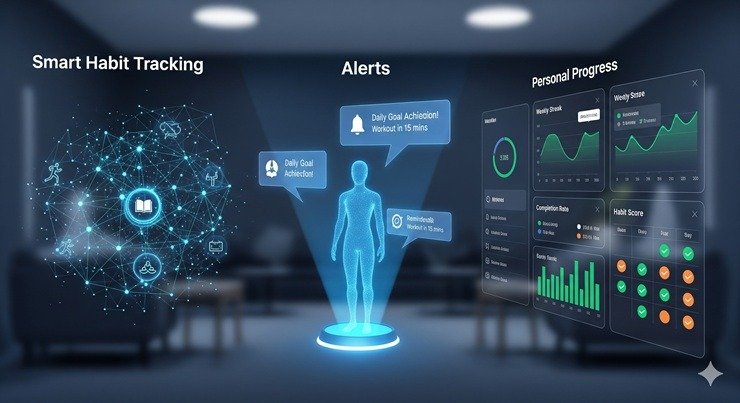
    But what if your habit tracker could be more than just a passive observer? What if it could be an active, intelligent partner in your journey of self-improvement? Welcome to the new era of personal development, enhanced by Artificial Intelligence. Smart habit tracking, which leverages powerful AI services to provide AI-driven alerts and dynamic progress dashboards, is transforming the way we build a better version of ourselves.

    The Limits of the Humble Checkbox

    For decades, the core principle of habit tracking has been based on Jerry Seinfeld’s “Don’t Break the Chain” method. While effective in its simplicity, this model has significant limitations in our complex, data-rich world:

    • Insight Scarcity: A calendar full of ‘X’s tells you that you did something, but it does not tell you why or how. It does not reveal the hidden patterns. Did you consistently miss your morning run on days following a late night? Did your writing output double on days you meditated? A simple checkbox cannot connect these dots.
    • The “All-or-Nothing” Mindset: Breaking a long streak can feel catastrophic, leading many to abandon the habit altogether. This rigid system doesn’t account for the nuances of human life. It punishes deviation instead of encouraging recovery.
    • Generic Reminders: “Don’t forget to drink water!” Your phone pings you with a generic reminder at 2 PM. It is the same reminder everyone else gets, regardless of your personal schedule, current activity, or actual hydration levels. More often, these “dumb” notifications become background noise we learn to ignore.
    • Reactive Analysis: You are the one responsible for looking at the data and figuring out what went wrong. It requires a level of self-awareness and discipline that is often in short supply, especially when you are already struggling with a habit.

    Enter AI: Your Personal Data Scientist and Coach

    Imagine having a personal coach who watches over your progress 24/7, understands your unique rhythms, and offers tailored advice at the exact moment you need it. This is the promise of AI-integrated habit tracking. By leveraging machine learning algorithms, these smart systems move beyond simple data logging to provide predictive, personalized, and actionable insights.

    The AI does not just see a collection of data points; instead, it recognizes a pattern. It analyzes your inputs of habit completions, journal entries, sleep data from your watch, and meetings from your calendar to understand the intricate web of your life. It becomes your personal data scientist, dedicated to one subject, and that’s you.

    This intelligent analysis fuels the two most revolutionary features of modern habit-tracking platforms – AI alerts and the smart personal progress dashboard.

    The Power of the Smart Alert: More Than Just a Nudge

    The difference between a standard reminder and an AI-powered alert is the same as that between a generic road sign and a GPS offering a real-time detour around a traffic jam. Smart alerts are all about context and timing.

    Here’s how they are changing the game:

    Predictive Alerts: By recognizing your past patterns, the AI can anticipate future challenges.

    • Example: The system notices you almost always skip your 30-minute reading goal on days you have back-to-back meetings after 3 PM. It might send an alert at 11 AM: “Your afternoon looks busy today. It’s a great time to get your reading session in now to stay on track.”

    Contextual Alerts: These systems can integrate with your phone’s other functions, like GPS and your calendar, to provide hyper-relevant nudges.

    • Example: You have set a goal to go to the gym three times a week. Your phone’s GPS notes that you are driving past your gym on your way home from work, and your calendar shows you have no evening appointments. You might get an alert: “You’re just two minutes from the gym, and your evening is free. Perfect chance for a workout!”

    Motivational Alerts: The AI learns what kind of encouragement works for you. Instead of just celebrating a streak, it can frame your progress in more meaningful ways.

    • Example: “Great job hitting your water intake goal! This is the 15th day of this month. At this rate, you are building a truly automatic healthy habit.” This reframes the effort from a daily chore to a long-term identity shift.

    Course-Correction Alerts: This is where AI truly shines as a coach. When you stumble, it helps you get back up intelligently.

    • Example: You have missed your “code for one hour” goal for two days in a row. Instead of a guilt-inducing “You broke your streak!” message, a smart alert might say: “Life can get in the way. How about we aim for a manageable 20 minutes today just to regain momentum? Small wins are powerful.” This approach champions consistency over intensity and prevents total abandonment.

    The Intelligent Dashboard: Your Progress Story, Visualized

    The second pillar of this revolution is the smart dashboard. It transforms that static grid of checkmarks into a dynamic, interactive command center for your personal growth. It does not stand just as the past record but also as a blueprint for future moves.

    An intelligent dashboard provides:

    • Correlation Insights: This is the magic bullet. The dashboard can generate charts that overlay different habits and data streams. You might see a clear visual correlation between the days you get 7+ hours of sleep and the days you successfully complete your “no sugar” goal. This data-driven proof is far more compelling than a mere hunch.
    • Holistic Well-being Metrics: By integrating with health apps like Google Fit or Apple Health, sleep trackers, and even mindfulness apps, the dashboard can present a unified view of your well-being. It can show how your new meditation habit is impacting your resting heart rate or how your hydration goal is affecting your reported energy levels.
    • Dynamic Goal Adjustments: The AI can analyze your performance and suggest data-backed adjustments. If you are consistently exceeding your goal of reading 20 pages a day, it might suggest increasing it to 25. Conversely, if you are consistently failing a goal, it might recommend breaking it down into a smaller, more achievable “micro-habit.”
    • Trend Forecasting: Based on your current trajectory, the dashboard can project your progress over the next few months, showing you the powerful cumulative effect of your daily actions. Seeing a projection of how many books you’ll have read by the end of the year can be a powerful motivator.

    The Human in the Loop: AI as a Partner, Not a Dictator

    It is normal to be concerned about privacy and autonomy. The trick is to see this technology as a partner and not a tyrant. You are always in control. You decide which data to share and which advice to follow. The AI’s role is to illuminate the path and offer intelligent suggestions; your role is to walk this road. The best platforms are built with privacy at their core, ensuring your personal data is secure and used only to benefit you.

    The future of personal development is proactive, personalized, and compassionate. We are moving away from rigid, one-size-fits-all systems and toward intelligent frameworks that understand and adapt to our unique human experience. By harnessing the power of AI, we can finally transform our habit trackers from simple scorecards into wise, data-driven companions on our lifelong journey of growth. The goal is no longer just to avoid breaking the chain but to build a stronger, more resilient, and more self-aware you.

  • A List of Affirmations to Use Right Now to Create a More Positive Life

    Positive affirmations are statements that change your thought process positively. You can achieve anything and everything in the world if you equip with affirmations. 

    Affirmations help you bring mental images, motivate and keep you focused on accomplishing your goals. They create positive vibes and help manage your time. They reinforce your inner voice. 

    They help you take a step closer to your ideal mindset with a positive, right, and strong attitude. They enhance your longevity as you enjoy living for a longer time with optimism.

    They keep you happy and help you lead your personal, professional, and social life successfully. They purify your thoughts and inspire you to dream and achieve big. You begin to think that everything is possible in this world. 

    Research shows that we get around 50,000 to 60,000 thoughts in a day and most of them are negative. 

    Hence, it is essential to convert negative thoughts into positive thoughts through affirmations. Life becomes truly great when we can think positively and contribute constructively to make a difference in the lives of others.

    Tips to Acquire Positive Affirmations

    “You will be a failure until you impress the subconscious with the conviction you are a success. This is done by making an affirmation which ‘clicks.’” ―Florence Scovel Shinn 

    Everything depends on your mind. Your thinking will create magical words that inspire and mesmerize the people around you. Here are some tips to affirm yourself positively: 

    • Appreciate yourself. Look at the positive things within yourself. In the morning, think of the good things you will do throughout the day. In the night, think of the good things you have done through the day before you sleep.
    • Use sentences such as “I can do it” or. Use the letter ‘I’ to affirm yourself. Tell yourself, “I am full of energy and that gives me joy”. Or “I forgive those who have hurt me”. These sentences bring a lot of change in your thought process and help you to calm down.
    • Use present tense in your statements to become optimistic and achieve maximum outcome. That tells you, what you said is your state of mind now. It is not a future goal or a quality of the past.
    • Surround yourself with motivational slogans. Take out five minutes to find a motivational quote of your choice every day. 
    • To apply affirmations, remove negative thoughts from your mind and replace them with positive thoughts. For example, instead of thinking “This is going to be difficult”, think rather, “There are some challenges here and it will be fun to overcome them.”
    • Prepare a few positive affirmations that suit your age, expectations, and passion. Repeat them. They will creep into your subconscious mind and convert your thought process positively. Once the messages are ingrained in your subconscious mind, your behavior will improve automatically.

    Wayne Dyer remarked, “My favorite affirmation when I feel stuck or out of sorts is: Whatever I need is already here, and it is all for my highest good. Jot this down and post it conspicuously throughout your home, on the dashboard of your car, at your office, on your microwave oven, and even in front of your toilets!” Above all, look at the door that is open, not the one that is closed. 

    “All that we are is the result of what we have thought. The mind is everything. What we think we become.” ―Buddha

    Change Your Mental Vocabulary

    James Allen said, “All that you accomplish or fail to accomplish with your life is the direct result of your thoughts.” Whether you want to succeed or fail, it is in your hands as your thoughts will lead to actions. When your thoughts are positive, your actions will be positive. Here are some techniques to convert your thoughts into positive action: Replace “if” with “when,” “should” with “could you,” “hopefully” with “certainly” and “I hope” with “I expect.”  Do not think about what you do not have. Think about what you have. Do not say, “Have a great day!”  but say, “Make it a great day!” Never say, “Do not worry”. Always say, “Have faith”.  Swapping a few words while speaking can convert you into an exceptional achiever.  For instance, swap “but” for “and”; and “have to” for “want to,” and you will find an amazing difference in your thinking process.

    Write down your affirmations in a journal and read them before you go to bed and when you wake up. Do it regularly because it helps the affirmations enter into your subconscious mind easily giving you amazing results. 

    Here are some examples of affirmations you can customize and adopt: 

    1. I exercise every day and I am healthy. 
    2. I always learn and grow. 
    3. I always see the good in others and appreciate it. 
    4. I forgive people and forget unpleasant events. I am compassionate and kind at heart. 
    5. I am surrounded by healthy and positive people. 
    6. I always get what I want. 
    7. I become more and more prosperous every day. 
    8. I attract incredible opportunities to increase my earnings and better my life. 
    9. I have a continuous abundance of prosperity flowing to me. 
    10. I allow all good things to come into my life and I enjoy them.
    11. I am an abundant person. 
    12. I have a loving family. 
    13. I read great books and enjoy sharing my knowledge with the world free of charge.  
    14. I am blessed with loyal fans and followers all over the world. 
    15. I have an attitude of gratitude. 
    16. I am blessed with affectionate and reliable friends.
    17. I am happy and successful. 
    18. I have a heart to serve others. 
    19. I always add value to others and make a difference in the world.
    20. I inspire the world.  
    21. Life is great!

    When you want to grow as a leader, you must create a positive and healthy thought process to build your confidence. It is essential to be equipped with positive affirmations. 

    Equipping with positive affirmations would be easy when you adopt the outlined techniques. Follow the tips, tools, and techniques to acquire, equip and apply positive affirmations that would help you reach your goal. 

  • Positively Present’s Thoughts on Toxic Positivity

    As I’ve seen tremendous growth on Instagram over the past few years (which I’m certainly not complaining about!), I’ve also seen a rise in angry, unkind, and negative comments. This is to be expected, but when you’ve been doing this for a decade and are only now facing resistance, it’s admittedly a bit of an odd feeling. It’s new. And it’s not great.

    Coupled with this strange, new feeling is the notion that, because my brand is all about being positive (a word that clearly has a variety of meanings for people, which we’ll get into in a bit), I’m expected to behave in a certain way. Anything response I give that’s not 100% cheerful, positive, uplifting, or agreeable is almost always followed by some version of, “well, that’s not very positive of you!”

    The more I receive that kind of response, the more I realize people don’t fully understand what I mean when I’m talking about positivity. And more and more, I’m receiving comments not only about my responses not being positive, but also about my content promoting what’s known as “toxic positivity.”

    Last week, I posted the image seen above on Instagram, and received a surprising number of comments related to toxic positivity, such as…

    “You seem like one of those people who tell people with actual depression, anxiety, insomnia, and other mental health issues that they should just think differently and it will go away.”

    “I’m really happy for you if a positive mindset brings you further in life, but don’t erase the voice of those who don’t follow your path.”

    “Positive thoughts backed by negative emotions is just negativity with a bow on it.”

    “Positivity can be toxic. If you are hoping for the best, you will be let down when the worst happens.”

    “Positivity doesn’t work because it doesn’t deal with the actual problem.”

    If you haven’t heard of toxic positivity before, it’s the idea that suggesting people be only positive, happy, and cheerful causes more harm than good. I agree with that. That’s why you’ll never see me post “good vibes only” or “if you want to be happy, be.” Happiness isn’t my goal in life — and it shouldn’t be yours either. Happiness is great, but it’s an emotion and, depending on your genetic makeup and your current situation, it might impossible to achieve. Positivity, on the other hand is a mindset, and one that can be chosen at almost any time. I’ve written about the differences between happiness and positivity before in “Happiness vs. Positivity: What’s the Difference?” but I thought I’d take some time this week to address my understanding positivity in relation to the concept of toxic positivity.

    • Toxic positivity is referring to happiness (it should really be called “toxic happiness”); positivity and happiness are very different. As discussed in detail in the article referenced above, there’s a big difference between happiness and positivity. Happiness is an emotion. Positivity is a mindset. Chasing happiness can be problematic (and often leads to unhappiness because, great as happiness is, it’s a temporary emotional state and does not last). Pursuing positivity is not problematic because it is a mindset, not an emotion, and it can typically be accessed no matter what your emotional state might be. You cannot always be happy. You can almost always be positive.
    • Toxic positivity encourages ignoring negative emotions, but true positivity is not about avoiding, glossing over, or repressing emotions (positive or negative). A positive mindset is about accepting all emotions and doing whatever possible to work through them, understand them, and garner more self-awareness. I, personally, am often very unhappy, anxious, stressed, etc., but I do my best to take what I’ve learned over the past decade of working on being more optimistic to stay positive. The words “be positive!” don’t mean avoid bad feelings. It means do what you can with what you have to make the best of the situation (or at least don’t make it worse).
    • Toxic positivity presents itself as something anyone can do at any time, but positivity is a mindset that doesn’t often come easily and must be worked at for most people. Though it is certainly very difficult at times, choosing a positive perspective is possible most of the time for most people. Happiness, however, is not accessible just because you want it. If something horrible has happened to you, you can’t just be happy. You can, more often than not, be positive. Certainly there are situations (such as extreme depressive states or in the midst of a panic attack) when optimism does not feel like an option (it can be so difficult at times or the brain might be wired in such a way that it feels impossible), but, more often than not, positivity is possible in a way that happiness might not be. However, it does take work and practice to know how to find optimistic outlooks in difficult times. For a lot of people (and especially for me!), a positive mindset doesn’t come easily and it requires a lot of work to develop it.
    • Toxic positivity embraces a fake-it-till-you-make-it attitude, but positivity isn’t about putting on a fake smile or feigning cheer. Smiling, acting cheerful, etc. are all about the emotion of happiness. Pretending you are feeling good when you’re miserable is not what positivity is about. It’s important to remember that you can work on positivity; it’s a skill. Happiness is an emotion. Yes, sometimes you can find ways to access it (like doing things or being around people who make you feel happier), but you can’t force it. You can present outwardly that you’re happy, but deep down, you can’t make yourself happy if you’re not. You can, with practice and the right mental toolkit, find ways to be optimistic. Which leads me to the last (and perhaps most important point)…
    • Toxic positivity aims for good vibes at all times; positivity won’t necessarily make you happy. If you are going through a difficult time, if you are dealing with depression, if you have intense anxiety and it’s been triggered, being positive isn’t going to make you happy. The thing about positivity is: it doesn’t necessarily make things better; it just doesn’t make them worse. Positivity is not the same as happiness and it will not necessarily make you happy. Positivity isn’t a cure for your emotional state; it’s a mindset to adopt when life is difficult (and also when it’s great). It will not change the world around you; it will only impact the way you see it.

    Toxic positivity should actually be called toxic happiness because the “just be happy!” attitude has nothing to do with maintaining an optimistic outlook. Positivity is about assessing the situation, understanding your feelings, looking to see if there’s anything you can do to make the situation better, and, if there’s not, doing what you can do make the most of whatever the situation is. It’s not about pretending. And it’s definitely not about happiness.

    When people come by this page or follow me on Instagram, they see the bright colors and the cute illustrations and assume that I’m a happy, cheerful, life-loving person without a care in the world. The truth is: I’m just a normal person. I’m someone who has had anxiety my entire life. I’ve been depressed (not just sad, but actually depressed). I’ve had some really bad things happen to me. For the past decade, I’ve been working on living more positively in the present, and I still have highs and lows just like everyone else. I’m happy sometimes, sure, but I certainly wouldn’t classify that as one of my top emotional states. And, as long as I can keep being positive and doing my best to live in the present, I’m okay with that.

    A Note about Optimism on Instagram

    Writing the article above got me thinking about how my content is perceived on Instagram, so here are a few thoughts on that…

    I spend a lot of time creating my posts for Instagram. This isn’t just me doodling for a bit and then posting. When creating the post referenced above, I thought very carefully about the words I chose to use. I specifically did not use “depressed,” for example, because, while it is possible to be depressed and positive, it is often so challenging that it feels impossible. Likewise, I chose the word “can” because it means that it’s an option. If you’re sad, you can be positive, but you don’t have to be. Also, the notion that you can be two things at once is the core message of that illustration. Our emotional states are often very complex, and we should allow ourselves the freedom to feel multiple things at the same time.

    When I’m creating something that’s based entirely on my own ideas (not a quote someone else said), a great deal of time goes into really thinking about whether the words I’m writing are true. I’m incredibly analytical by nature, so when I’ve posted something (especially on Instagram), I’ve typically spent a lot of time reflecting on how it might be perceived. I do my best to look at it from a number of points of view and assess if it might be misconstrued or misunderstood. It might just look like cute little drawings to the average viewer, but a lot of thought goes into the words and images I choose.

    That being said, I’m also creating things that I need to see, writing words that speak to what I’m struggling with in that moment. Though the Positively Present brand has grown over the years, is still me, Dani, trying my best to cope with my own negative, anxious, and melancholic mind. What is true for me might not be true for everyone else. I’m not a doctor, a therapist, or a guru. I’m not psychologist, authority figure, or philosopher. I’m a creator, sharing my experiences with the world.

    So, whether it’s something on my Instagram account or something you’ve seen elsewhere online, I’d urge you think critically and with an open mind before making judgments or remarks about the content. What you see might not speak to you, but it might be true and useful for someone else (and, in the example of this particular post, I know it resonated with a lot of people). When it comes to the content you see on my page or pages like mind, keep an open mind. Take what works for you, and understand that not everything will. And know that, at least in my case, I’ve spent a lot of time thinking about what I post. It might look pretty and light-hearted, but behind every post there’s a lot of time spent thinking, analyzing, and carefully choosing words that I hope will help people (and me!) get better at living more positively in the present — regardless of whether or not we’re currently happy.

  • How to Be in the Moment

    Staying present is challenging, even for someone like me, who’s dedicated her life to trying to be more positive and present. Mindfulness is especially when dealing with difficult times, but that’s precisely when we most need to practice being present — when we find it hard to do so!

    There is no shortage of tips and tricks for being more mindful, but I’ve rounded up my six favorites. My new book, Into the Moment: A Journal and Coloring Book to Inspire Mindful Creativity, is included in one of them because, from years of experience, I’ve learned just how important mindful creativity can be to making the most of your moments.

    Creativity is one of the best ways to practice mindfulness, but it can sometimes be difficult to know how to get started (especially if you don’t consider yourself a creative type) so I created Into the Moment to help with that. It’s a coloring book and journal filled with activities, quotes, and prompts to inspire mindful creativity.

    Whether it’s through creativity or one of these other suggestions, I hope these ideas help you find ways to the present moment because, truly, it’s all that we have.

    How to Be in the Moment

    1. Avoid Over-Scheduling Your Time. The more slowly you’re able to do something, the easier it is to be mindful while doing it. But if you have lots on your plate and your planner is jam-packed, it’s going to be hard to go slowly. Whenever possible, keep your schedule open and give yourself extra time to get things done. Not rushing will allow you to slow down, which leads us to our next point…
    2. Be Grateful For Life’s Little Delights. When you’re going slowly, you’re able to more easily notice the little things in life. If you’re driving slowly, you’re going to see autumn leaves floating down from the treetops. Regardless of your pace, do your best to look around you and notice the little things. Start a gratitude journal if you can. They’re cliche, but they really encourage mindfulness.
    3. Switch Up Your Regular Routines. When you’re doing the same thing day in and day out, it’s hard to be mindful. Everything gets set on autopilot. When you can, try to take a different route to work or school. Or do a task in a different order. Or try something new for a meal. When you’re experiencing something new (or from a new point of view), it’s easier for your mind to pay attention and be in the moment.
    4. Tune Into What You’re Feeling In Your Body. Your body is a gateway to the present moment. When you take time to notice what you’re feeling, you’re instantly bringing yourself into the moment. If you find yourself struggling to be mindful, take notice of what your body is feeling, and you’ll be connecting to the moment. The great thing about this is that you always have your body with you so you can use it as a mindfulness tool wherever you are!
    5. Do Something Mindful & Creative. For me, the easiest way to bring myself into the present moment is to do something creative. When I’m creative is when I’m most likely to get in the flow state (that state of mind when you’re so engaged in the present that you forget about time altogether). If you struggle to feel creative, check out books like Into the Moment that can help you connect to your creativity.
    6. Spend Time In Nature (Without Your Phone!). Of course, you’ve heard it before: connecting with nature helps you return to the moment. It’s a mindfulness cliche, but it’s for good reason. Being in the natural world, even if it’s in a city park surrounded by skyscrapers, helps ground you into the moment. When you find yourself disconnected from the present, put your phone away and step outside. You’ll be back to the moment in no time!

    These are only a few of the many ways you can make it easier to practicing being present, so if none of these feel like the right fit, I highly recommend you peruse the mindfulness section of the blog for additional ideas. Staying present is so important, and it’s rarely easy to do, but the effort is worth it.

    Want to support Positively Present? Here are some ways to support the work I do!

    • Sign up on Patreon
    • Shop for workbooks, Out of Your Mind and Into the Moment.
    • Buy my books, Grow Through It and Everyday Optimism
    • Order the 2025 desk calendarcalendar, or planner.  
    • Download digital workbooks
    • Purchase art prints
    • Check out the sticker store

  • Make your dreams a reality

    When something comes into my mind, I am eager to have it. By 30s I’ve achieved many of my dreams and now I am making new ones. I have a career, I work, I teach yoga and meditation, plus I travel; something that most of the people would plan to have by their 60s. But all of this wasn’t simple to achieve. Coming from Latina style of organizing things, it wasn’t something natural; I don’t have a culture where our main priority is planning and organizing, not at all. I could say it’s completely the opposite. That is why the next tips that I will share with you I know they will really work because I have done them myself and they’ve helped me achieve many different things.

    Create a list of all your dreams

    In order to have a clear idea of your dreams, it helps you to be aware of what exactly you want. Visualize it.

    I like the phrase in Alice in Wonderland when Alice meets the Rabbit and asks him which road to take. She had two options and the rabbit answered: it doesn’t matter which road you take if you don’t know where you’re going. This is why we need to be sure where we want to go, have a clear idea of what we want to achieve. Write your dreams, make them as clear as you want, describe perfectly with all the details you can, add colours like the colour of the car you are dreaming of having or you can add emotions, for example, what emotions you want to feel in the relationship you are wishing to have.

    Make it a goal

    Make your dreams a goal. By goal I mean steps to achieve your dreams. For example, if you want to travel the world, your goal could be visiting a new country every year. If your dream is to have a happy life, start by listing all the activities that make you happy. Goals have to be measurable and concrete.

    One of my intentions in 2018 was to have a better connection with my family, but this goal was too undefined and hard to accomplish or to measure. If I wanted to make it a clearer goal, I would say: I will call my mom and dad once a week or every Sunday. Is your goal to become happier? So start creating goals that are linked with what makes you happy. My friend had a dream of becoming a writer so she planned her first book and worked on it every day for at least 15 minutes.

    Create a schedule

    Once your goal is measurable, it is time to put it on a schedule. Will you achieve it in one year or three years? Use a calendar to mark how much you progress each day, week and month. 

    Sounds like a project? Yes, your dreams are becoming your priority and you are your number one project! Use your calendar to create your own challenge or to create a new habit. Normally people plan these at the beginning of a new year, but any day is a good day to start, every month, every week or every new or full moon.

    Meditate and control your mind

    Achieving what you want is very much related with willpower and the best way to gain willpower is to control your mind. The number one technique to control your mind is meditation. Scientifically proven meditation will give you many benefits and one of them is the power of self-control and willpower. In order to achieve what you want, you need to say NO to some things and have the energy to do others. Hence, it is important to have the control of yourself and of your mind.  

    Meditation helped me become focused and committed to my goals. I wanted to learn yoga and I had to make time on my daily schedule for my practice and this means leaving behind other things I liked to do like watching my favourite TV shows. It was hard at the beginning and time-consuming but it ends up being more beneficial for me and in the end, leaving behind other things did not matter to me as I was focused on my goal of learning yoga.

    Let go of negativity 

    Your mind can also be your number one obstacle, so removing negativity from your goals is very important. Know that a lot of people are achieving more with less than what you have. Negative thoughts or ideas will be your number one obstacle when it comes to achieving your dreams and normally these are wrong ideas about you and what you can achieve.

    Negativity is just created in your mind, so observe your thoughts when you are creating the life that you want, and when a negative idea pops up, let it go. Burn it. It has to despair, normally we worry too much of things that will never happen.

    I used to dream about travelling the world and my negative thoughts were: I don’t have the money or I don’t have time. By now I have travelled to around 20 countries. You don’t need money to travel, you can find a scholarship abroad or volunteer in another country. Time? If you really want it, you will find time for it.   

    Look for inspiration in other people

    Tell your friends about your goals, tell them to support you. Find role models, people that have already done it so they can share with you their experience.

    My main role models are my friends – inspiring people that are the same as all of us, beautiful souls that want to change their world by simply living a happy life and supporting others to be happy. All of them have shown me that they practice these tips or have taught me one of them.

    Which dream will you start working on today? 

  • Meditation is the Key to your Real Development: Here is Why and How

    In our quest for personal growth and self-improvement, we often find ourselves struggling to stay motivated and consistent in our efforts. Passion and enthusiasm alone may not be enough to sustain us on the journey towards becoming the best version of ourselves. However, there is a powerful tool that can help us overcome these challenges and pave the way for real development: MEDITATION.

    Before delving into the role of meditation, let’s understand the significance of self-image and self-ideal. Self-image refers to our perception of ourselves in the present moment, while self-ideal represents the future version of ourselves that we aspire to become. It is natural to have the desire to continually improve and bridge the gap between our self-image and self-ideal.

    WHY? The Struggle for Sustainable Change

    Many of us have experienced the frustration of trying to break bad habits and establishing new ones.

    The process of self-improvement often requires sustained effort and resilience. It is not as simple as just stopping a negative behavior and replacing it with a positive one. This is where the challenge lies – how can we make lasting changes and maintain consistency?

    Meditation, contrary to common misconceptions, is not a religious or cultural practice. It is a mental exercise that allows us to achieve a state of stillness, focus, and inner peace. What initially drew me to meditation was its unique perspective on self-development and its potential to strengthen our willpower.

    HOW? Developing Willpower through Meditation

    Willpower can be defined as the strength of character or resoluteness to persevere towards our self-ideal. Meditation acts as a catalyst in developing this willpower. By cultivating a regular meditation practice, we can enhance our ability to stay committed to building new habits and sustaining them over time.

    Meditation acts as a prop, providing stability and balance on our journey towards self-improvement. It helps us build and reinforce habits, overcome obstacles, and maintain sustainable growth. Just like a hiking pole supports us on a challenging mountain climb, meditation supports our progress towards our goals.

    Here are two important benefits of incorporating daily meditation into your self-development journey:

    • Cultivate a Positive & Growth Mindset: Self-limiting beliefs can often hinder our growth and progress. Thoughts like “I can’t do it”, “I am not ready”, or “I have never done this before” can hold us back.

    Daily meditation helps combat these thoughts by fostering a positive outlook on everything. It allows you to cultivate a mindset of growth and resilience, enabling you to overcome obstacles and reach your full potential.

    • Attain a Calmer and Clearer Mind: Daily meditation helps achieve a calmer and clearer mind. In our day-to-day lives, we often face stress and overwhelming responsibilities at work, school, or in our personal lives. This mental clutter can hinder decision-making and lead to giving up on our goals.

    By incorporating meditation into your daily routine, you create space for mental clarity and peace. This allows you to make decisions that align with becoming the best version of yourself, overcoming challenges with a sense of calm and focus.

    Daily meditation is indeed a powerful practice for achieving a daily push towards your self-ideal.

    Be reminded of the opportunity to meditate with the World Peace Initiative through The Mind Stories Program. I encourage you to join these sessions either on Mondays or Thursdays at 7 PM Thai Time. This will further provide valuable guidance and support on your meditation journey.

    Embrace this opportunity to cultivate inner peace and personal growth. Take a step towards a brighter future by immersing yourself in the transformative power of meditation. Remember, the path to self-discovery begins with a single breath.